

I was working on a project tonight and discovered a "new" feature in PHP which will be rather useful. This feature had me intrigued as to when it was implemented which led me down a rabbit hole about specifically when it was published. PHP offers a good abridged history of the project but it doesn't go into detail of the actual versions.
As such, I decided to compile a list of all initial versions, when they were released, and the final version of the branch.
Branches are organized by major version + minor version, so for example "5.0" and "5.1" are listed separately.
List compiled from PHP museum and PHP historical releases.
"*" - PHP 8.2 and 8.3 are currently under security support and PHP 8.4 and 8.5 are under active support at the time of writing, so additional versions may be added.
As indication from the timeline, a goal of the PHP foundation is to release a new minor build every year. These scheduled releases generally offer some new functionality, better performance, or more security features. Having the 1-year timeline between releases gives the core development team time to prepare features for the next release.
For major architectural changes, such as a new Zend Engine or major foundational changes, the major version is incremented instead.
Generally speaking, upgrading the same major.minor version is considered safe under most circumstances, so upgrading from PHP 8.4.1 to 8.4.18 is generally safe, (though testing should always be done as minor differences may cause bugs).
Upgrading between minor versions is usually safe, though some functions are liable to be deprecated when upgrading minor versions, with eventual removal.
Versions will continue to receive security fixes even after active development has ended, thus why many versions have patch versions up to X.X.33. For example at the time of writing PHP 8.2 is no longer being actively developed, but security issues are backported until the end of its security lifespan.
Patch version releases are generally deployed once a month. These versions include new features for actively developed builds and bug or security fixes for security support releases.
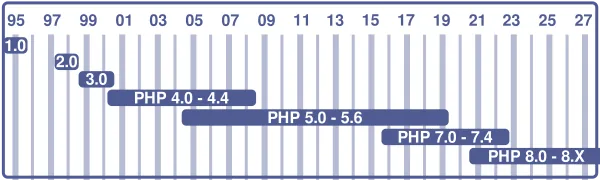
PHP 1.0 (June 1995): Originally "Personal Home Page Tools," this version provided basic functionality like Perl-like variables and form handling to track resume visits.
PHP 2.0 (November 1997): Officially PHP/FI 2.0, this was the first release characterized as a standalone language. It introduced database support (mSQL, Postgres95), cookies, and user-defined functions.
PHP 3.0 (June 1998): A complete rewrite by Zeev Suraski and Andi Gutmans. It introduced extensibility through modules, basic object-oriented programming (OOP) support, and the recursive name "PHP: Hypertext Preprocessor".
PHP 4.0 (May 2000): Introduced the Zend Engine 1.0, significantly boosting performance for complex applications. Key features included HTTP sessions, output buffering, and improved web server support.
PHP 4.1 (December 2001): Introduced superglobals like $_GET and $_POST
PHP 4.2 (April 2002): Disabled register_globals by default for security
PHP 4.3 (December 2002): introduced the CLI (Command Line Interface).
PHP 5.0 (July 2004): Powered by Zend Engine II, this version brought a revamped object model and the PHP Data Objects (PDO) extension for consistent database access.
PHP 5.1 (November 2005): Focused on maturing Zend II, standardizing the Data Object support, and performance fixes from features introduced in 5.0.
PHP 5.2 (November 2006): Introduction of web 2.0 features and a major focus on security with the introduction of filter extensions to validate and sanitize untrusted input.
PHP 5.3 (June 2009): Received backports from the 6.0 build including namespaces, late static binding, anonymous functions (closures), and garbage collection.
PHP 5.4 (March 2012): Traits and short array syntax, again from the 6.0 build. This build also added the option to run an embedded web server directly from PHP, allowing developers to test their code without needing a full web server.
PHP 5.5 (June 2013): Introduced generators and the finally keyword to allow for more performant code and better error handling.
PHP 5.6 (August 2014) The last major build for the 5.x branch; added constant scalar expressions and variadic functions.
PHP 6.0: Native Unicode
The primary goal of PHP 6.0 was to provide deep, native Unicode support throughout the engine and language, with all strings represented as UTF-16 objects, allowing developers to not worry about multibyte libraries.
Due to complexities with the migration and severe performance issues however, this version was never officially released, but features were ported into PHP 5 such as namespaces, late binding, and improved object support in PHP 5.3 and traits and short array syntax for PHP 5.4.
These issues also led to the lifespan of PHP 5.x being longer than originally expected, as no suitable production build was available of the next version.
Development builds of PHP 6.0 were available however and several books were published so despite never being officially released as a major version, it was decided to be skipped entirely to avoid any confusion with the abandoned branch.
PHP 7.0 (December 2015): Driven by Zend Engine 3 offered up to 2 times the performance gains over 5.x. It introduced scalar type declarations, return type hints, and the null coalesce operator ??. This was the first release to offer a real choice for developers to write type-safe code in PHP.
PHP 7.1 (December 2016): Added nullable types.
PHP 7.2 (November 2017): Included the Sodium cryptographic library into the core bundle, so developers wouldn't have to include the library from an additional package and officially removed mcrypt.
PHP 7.3 (December 2018): Performance and quality of life improvements over 7.2.
PHP 7.4 (November 2019): Introduced typed properties and preloading for even faster execution.
PHP 8.0 (November 2020): Introduced Just-In-Time (JIT) compilation, named arguments, union types, and attributes (annotations).
PHP 8.1 (November 2021): Added Enums, fibers, and readonly properties.
PHP 8.2 (December 2022): Added readonly classes and DNF types
PHP 8.3 (November 2023): Introduced typed class constants.
PHP 8.4 (November 2024): Notable for introducing Property Hooks, asymmetric visibility, and HTML5 support in the DOM extension.
PHP 8.5 (November 2025): Features include the pipe operator |> for better data transformation flows and chaining of return values, better clone support of objects, static closure changes, and improvements to asymmetric visibility for static properties as implemented in 8.4.
PHP 8.6 (November 2026): Planned features for the upcoming release include partial function applications for closures by using a '?' placeholder, native clamp function, and improved JSON decoding. True asynchronous support is being discussed, though I suspect that won't be published until PHP 9.0.